
What Is TDEE? The Number That Explains Why Your Diet Isn't Working
"I'm eating 1,200 calories a day and the scale won't move."
I get a version of that message every single week.
And almost every time, the same two things turn out to be true. One: she's not actually eating 1,200 calories. Two: even if she were, eating that little is part of the problem.
To understand why, you only need to understand one number. Your TDEE.
What is TDEE?
TDEE stands for Total Daily Energy Expenditure: the total amount of calories your body burns in a day.
It's also your maintenance number. Eat around your TDEE and your weight stays put. Eat under it and you lose. Eat over it and you gain. Every diet that has ever worked, worked because of this number, whether it admitted it or not.
Simple on paper. But here's where it gets interesting.
Where your calories actually go (not where you think)
Most women I talk to believe the gym is where calories get burned. The fitness industry has done a great job selling that story, because it keeps you buying workouts.
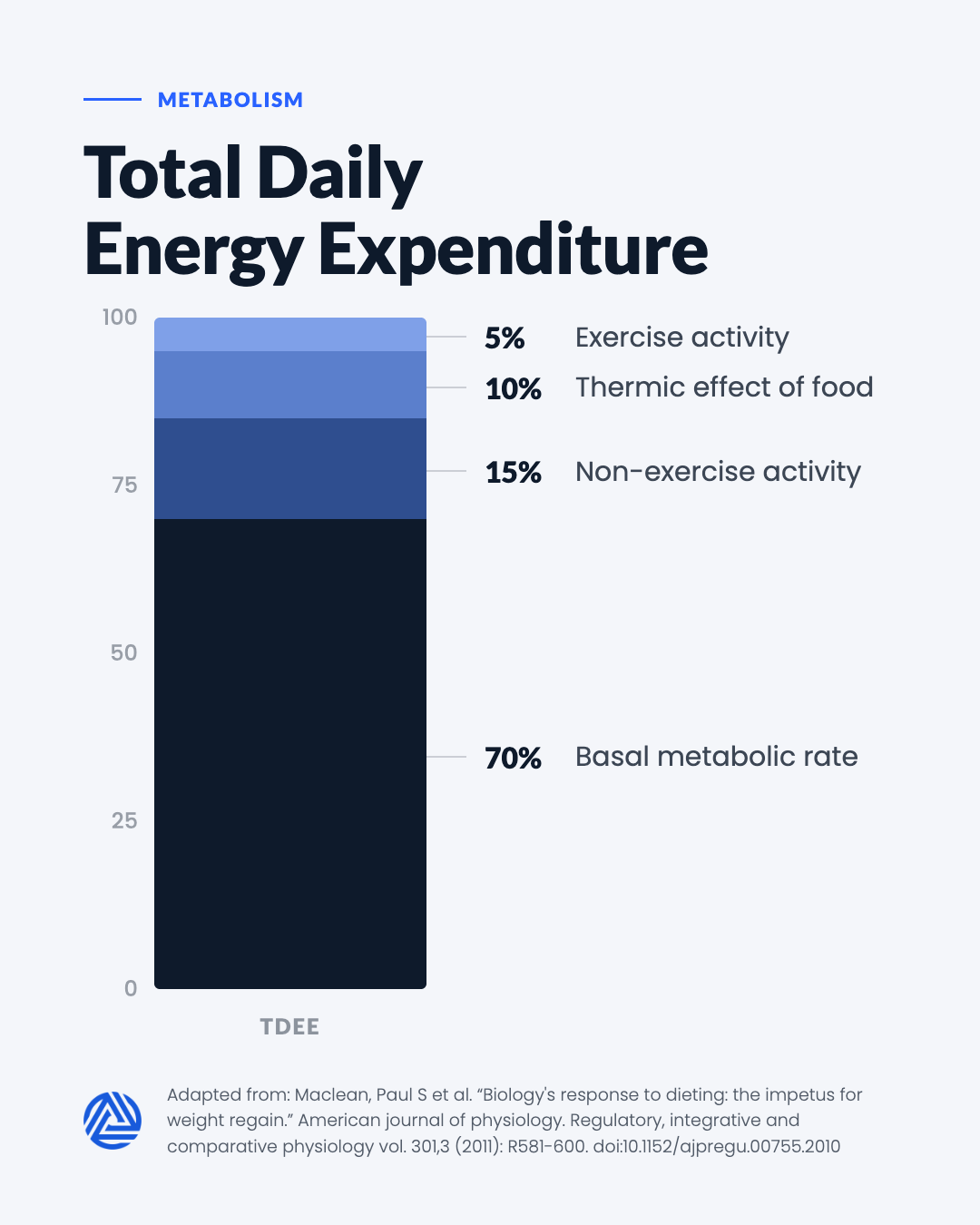
Here's the actual breakdown of your TDEE:
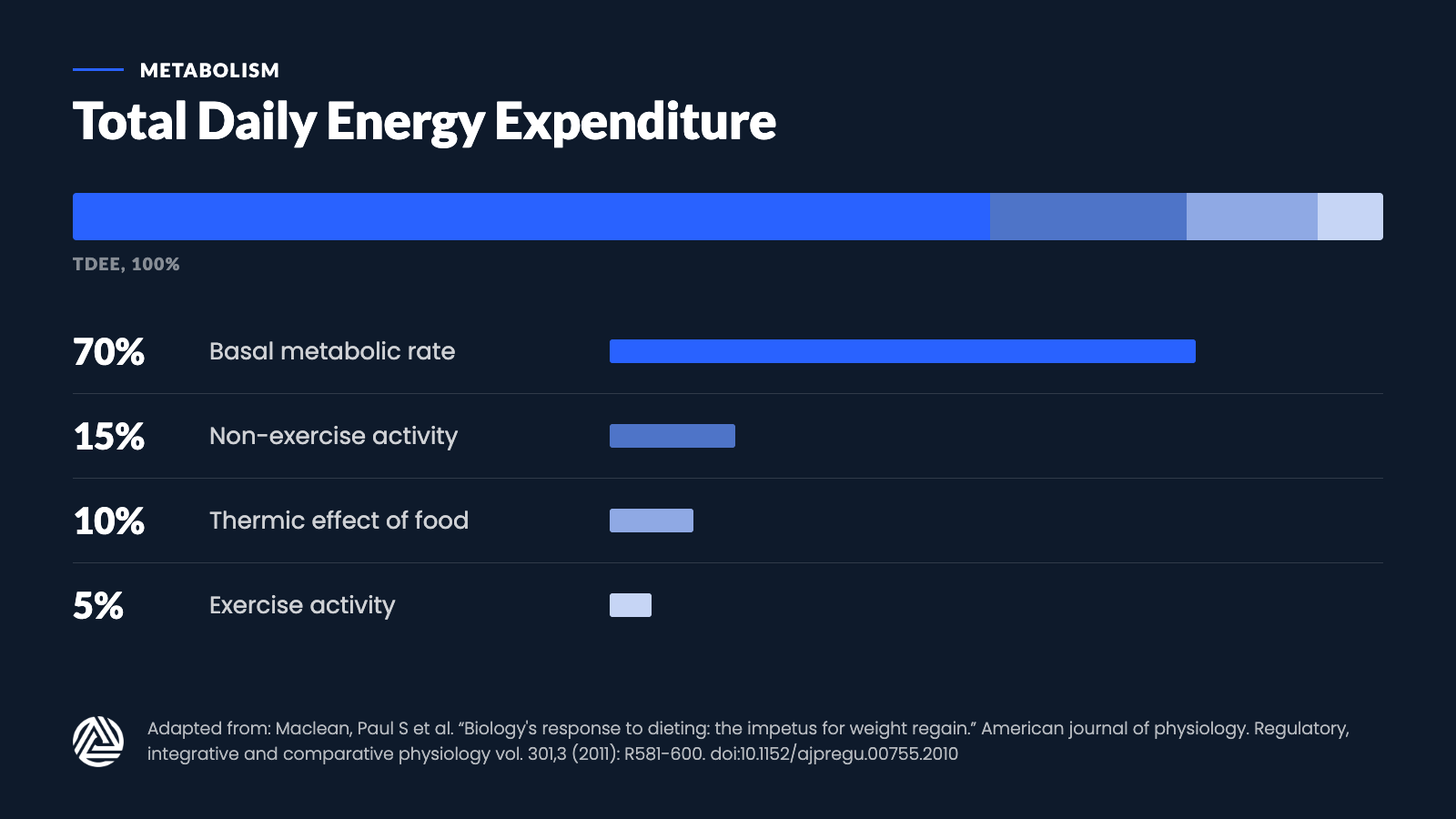
BMR (Basal Metabolic Rate) - about 70%. Calories burned just keeping you alive. Heart, brain, organs, body temperature. If you stayed in bed all day, you'd still burn this.
NEAT (Non-Exercise Activity Thermogenesis) - about 15%. All the movement that isn't training: walking, cleaning, gesturing while you talk, fidgeting. This is the most changeable piece of the whole equation.
TEF (Thermic Effect of Food) - about 10%. Calories your body burns digesting food. Protein burns the most by far, which is one reason a high-protein diet works in your favor.
Exercise - about 5%.
Read that last one again. Your workouts are the SMALLEST slice of the pie.
That hour of HIIT you're doing to "earn" your food? It's a fraction of what your body burns on its own. Which is exactly why you can't out-train a body that's under-fueled, under-slept, and barely moving outside the gym.
Why chronic dieting makes this number shrink
Here's the part that matters most if you've been dieting on and off for years.
Your TDEE is not fixed. When you under-eat for long stretches, your body adapts. It turns down the thermostat: NEAT drops without you noticing (you move less, fidget less, take the elevator), digestion slows, and your body gets more efficient with every calorie. Your maintenance number slides downward.
So the harder and longer you diet, the smaller the gap between "eating less" and "maintenance" becomes. That's how you end up eating less than ever, gaining on amounts that used to be your deficit, and concluding your metabolism is broken.
Here's the difference that matters: a broken thing stays broken. An adapted metabolism can be brought back up. Just not by cutting further.
This is why every single one of my clients starts at maintenance, not in a deficit. We spend the first weeks finding her real TDEE and feeding her body at that level before we even think about fat loss. It feels counterintuitive. It's also the reason the fat loss works when we finally start it.
Want your starting number?
The OCS TDEE Calculator gives you your estimated maintenance calories in under a minute, plus targets for fat loss and muscle gain.
How to find your REAL maintenance calories in 5 steps
A calculator gives you an estimate. Your body gives you the truth. Here's how I do it with clients:
Track your food for a week, changing nothing. This is not the week to "be good." You want data on how you actually eat, licks and bites included. My clients use Cronometer.
Weigh yourself daily, first thing. Not to judge it. To learn how normal daily fluctuations are, and to see the weekly average, which is the only number that means anything.
After the week, look at your averages. Average daily calories, average protein, average weight. That's your real starting point, and it's usually a surprise.
Calculate your estimated TDEE and compare it to what you found. Eating well under it? That gap is your body running in defense mode.
Spend 2-4 weeks working up toward your estimated TDEE. Keep it simple: track calories and protein. Weight stable at that intake? You've found your maintenance. Now you have a foundation any goal can be built on.
PS. Don't bother trying to calculate calories burned. Trackers guess, and they guess badly. Focus on food and your daily steps instead.
The bottom line
You have a number you've never actually measured, and years of dieting that have pushed it down.
Find it. Eat at it until your body trusts you again. Then decide what phase comes next.
Start with your number
Free, instant, no email required: your estimated maintenance calories plus fat loss and muscle gain targets.